
Question of Christians and violence. = Thomas O'Loughlin
We gather today again to celebrate in the presence of the risen Lord. We are called to be the people who bear witness to his victory over death. We are the people who proclaim the Father’s forgiveness to the ends of the earth by being people who are forgiving.
1. The demanding stance on how Christians are to react to persecution in 1 Peter makes this a fine occasion to reflect on the ever present question of Christians and violence.
2. It is interesting to note the number of times that public figures quote scripture without knowing it (e.g. 'going the extra mile for peace' (President Clinton) is an allusion to Mt 5:41) and it is cited both with approval and non-approval. Invariably when one hears quotations on non-violence cited, they are implied to be feeble and silly, if not downright wrong: thus 'turn the other cheek' (Mt 5:39) is not presented as the statement of wisdom, but of a stupidity that acquiesces to evil. While few who declare themselves Christians take the hawkish position of 'take 'em on, take 'em out!', there is an awareness that one must stand up to bullies, those who abuse power, those who trample on other's rights, especially those who abuse the weak, poor, defenceless.
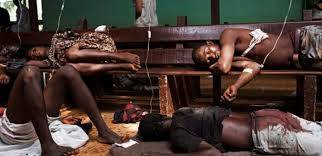
Amidst the continuing carnage in the Central African Republic, leaders of churches and mosques are jointly praying for peace Amidst the continuing carnage in the Central African Republic, leaders of churches and mosques are jointly praying for peace[/caption]
This dilemma has lead to the traditional unwillingness of the church to adopt a pacifist position. Pacifism has a simple attractiveness, but the pacifist must ask this question: is it right for me not to oppose someone who if not stopped will destroy not only me, but others who may not be able to stand up for themselves? While using force can appear immoral, pacifism too can be immoral in that I am passively collaborating in suffering being caused to others. Thus I may, in the exercise of my freedom, be destroying the freedom of others. Pacifism poses moral problems, and can be a selfish opting out of our moral responsibilities to others weaker than ourselves. This is a dilemma; but we are certain that those who set out to dominate others act evilly, and a wilful hawkishness cannot be reconciled with Christianity for which force is always a last resort.
3. However, the situation envisaged in 1 Peter is slightly different: how should Christians react when they are being persecuted as Christians - it is their behaviour precisely as Christians that is the issue. They are to give an account of their beliefs but to do so with courtesy. Put another way, they do make their stand known, but do not 'fight fire with fire'. They cannot have recourse to methods of bullying, force, or intolerance, for that would betray the Christ in whom they seek to live.
As Christ chose the way of gentleness, so when challenged Christians must act with gentleness: otherwise their words preach one thing, their actions another. This is a hard lesson: the recurrence of the notions of crusade and pro Deo et patria (God gets first billing, but usually takes second place) testify to this. And sadly these notions are far from dead, as various right-wing Christian groups demonstrate in their readiness' to fight for gospel values'. Their very militancy compromises the Christ they wish to serve.
4. Peter makes deep moral demands on us. As a Christian how fitted am I to give an account of my faith? Is my understanding of the Christian message a few' do's and don'ts' and some scraps of information remembered from school? Do I appreciate there is a Christian manner of action? Am I conscious of how others are persecuted for their beliefs, or feel a sense of solidarity with Christians who suffer elsewhere? As a member of a body which was born in persecution and whose head suffered on the cross, am I sensitive to the pain of all who are oppressed, and seek to alleviate their persecution? Is a document such as the Universal Declaration of Human Rights something that I consider should interest me as a Christian? Do I support those who support human rights? Painful questions, but can we be true to our origin if we shy away from them?
Thomas O'Loughlin
Liturgical Resources for the Year of Matthew
www.columba.ie