
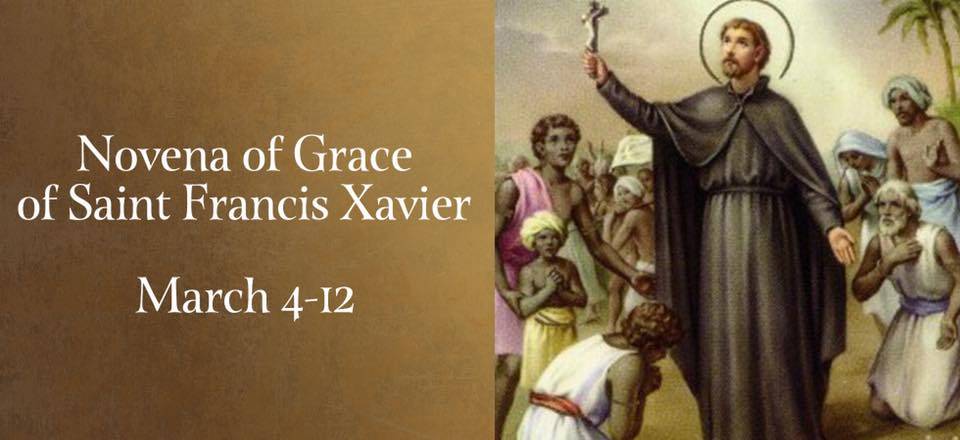
Novena of Grace Day 6
No prophet is accepted in his hometown. Every time I read that line, I always think of my mother, God rest her soul. Whenever she would lecture us, me and my siblings, we'd always laugh, and then she would say, ‘Ah, no prophet is accepted in her own place’. Okay, neither here nor there. Francis Xavier, where are we? We're talking more about Francis Xavier, and if you think back to the first day, one of the things I said was that the life of Francis Xavier, I think really,
There's a lot of good stuff in there that I think really can speak to us today where we are. We have this tendency as Catholics to take our saints, and we put them way up high on a pedestal. And when we do that, we almost make them inhuman, right? We make them something different than us. And we forget that, you know, they put on their pants in the morning the same way we did, we do, one leg at a time. I guess that painting would be tights. It was the same way we put on our tights in the morning, or cassock, or whatever. Anyway, you get the point. Francis Xavier was human like us. And I think in order to really find the grace in his story, find the ways that it speaks to us, we've got to scrape beneath some of the pious veneer that we put on him, some of the pious legends that we've attributed to him over time that make him seem like he's something different than you and I. And just a little plug for Father Brendan's book. Again, his book was really helpful for me in preparing this novena. And he does a very good job of scraping down underneath the pious veneer so that you can encounter Xavier, the man, Xavier, the human being.
And here's what I want to share with you today. Here's what I want to reflect on. That Francis Xavier, although he was a saint, he was far from perfect. Now, there's a passage in Scripture. It appears in the Gospels of Mark, Matthew, and Luke, and it's one that you're familiar with. Remember the one where Jesus says to the apostles, ‘Who do you say that I am?’ And some of them are like, Well, you might be John... some people say you're John the Baptist, some people say you're Elijah, and Jesus says, ‘Well, who do you say that I am?’ Do you remember what Peter says? He says, You are the Christ. And Jesus says, You got it right.
Now, Peter speaks a lot. He's got a lot of speaking lines in the gospel. And unfortunately, many times when Peter speaks, he puts his foot in his mouth first. But here's one of those moments where St. Peter gets it right. And you want to say, Well done, Peter, well done, you got it, you nailed it, A plus. But then two seconds later, what happens? Jesus says, Peter, that's right. I am the Messiah, and I'm going to go to Jerusalem, and they're going to arrest me and do bad things to me and kill me. And Peter says, No! Perish the thought, Lord. Peter starts objecting. And then you remember what Jesus calls him. ‘Get behind me, Satan.’
Now here's the curious thing, this is the thing I always laugh at in that scripture, that one moment we get Peter, who's scoring an eight plus, he gets it right, you're like, yeah, and two seconds later, Jesus is calling him Satan. Now how do you make sense of that? I take a lot of consolation in that. I can really sympathize with St. Peter. I think most of us can, and here's the thing, here's the point that I want to draw from that. that when Jesus calls us, he calls all of us, meaning he calls everything that makes us who we are. He calls the good and the bad. He calls us with all of our strengths and with all of our weaknesses. He calls us with all of our virtues and all of our vices. And what's more, he's able to use all of it, including our weaknesses, to build his kingdom. That's the amazing thing.
And so, you take somebody like Francis Xavier. Now, Francis was an intense guy. He didn't do anything halfway. He was all in. And he was, and this intensity is what propelled him in his mission. It's what kept him going year after year in the Far East, that passion, that energy. But it was also something that made him very difficult to live with. Xavier had some serious edges to him. He had a real temper. As Father Brendan mentioned the other day, one of the quips about Francis Xavier was that he smiled a lot, but he rarely laughed. He had some edges, especially when it came to other Jesuits. He had a very difficult time understanding how other Jesuits might not share his same passion and zeal. And so there was even one incident, and I'm going to forget the young Jesuit's name, and they were just, it was towards the end of Xavier's life, and they're just about to go to China, and this young Jesuit who knew that the Chinese would torture the prisoners, that they would get arrested and tortured, this young Jesuit said, ‘Um, Father, Maybe we want to think twice about this? I'm not so sure’.
Well, Xavier didn't just scold him. Xavier kicked him out of the Jesuits. And things got so bad, and there were so many complaints from Jesuits about Francis Xavier, that Ignatius had to write him a letter calling him back to Rome. Now, Xavier died before that letter reached. But there you go. He was a very, very human man. But here's the thing. Christ could use all of that. Imagine this for a moment. Imagine this. Imagine what would happen if you took away that edge that Xavier had, that kind of those rough edges. I fear that you'd lose his passion, too, because those two things were intimately connected. There's a songwriter, an American songwriter named Tom Waits. He has a wonderful line in one of his songs. He says, ‘If I exorcise my demons, my angels might leave too’. And there's something to that.
Now, if you feel a little scandalized by all this talk about Xavier and his weaknesses, I want to suggest that it might have something to do with the misunderstanding we have about what holiness means, that Xavier was very holy and he was very human, and those two are not opposed to one another. We have this idea in our heads that in order to be holy, we need to overcome all of our faults and failings and character defects. But in fact, sisters and brothers, what I want to argue today, what I want to reflect on today, or suggest, is that Christ uses our faults and our failings and our character defects to lead us to greater holiness. That Christ can use even our sins to lead us to greater holiness. How does that work? Well, if we're honest with ourselves, and we see our character defects, and we own them, and we admit to them, and that's the key part, then two things, we learn two things. Number one, we come to realize that we're not better than anyone else. I'm not better than you. You're not better than me. You're not better than her. We're all in this together. And so, coming to recognize our faults and failings can actually increase the compassion that we have for one another. Because we can come to a greater understanding. When somebody else is acting like a fool, we can come to understand that and we can say, Oh yeah, I do the same thing. so, it can increase our compassion.
Number two, that coming to own our faults and failings can also lead us to greater humility, where we turn to the Lord in prayer and say, Lord, I'm going to need your help with this one. Lord, it's been a long day at work, and I got to go home, and I got these kids who are going to be all over the place. I don't think I've got the patience today; I'm going to need your help with that. So, it can lead us to greater prayer, greater connection with the Lord. And so, our faults and failings are not things that we ought to be scared of. Now don't get me wrong, I'm not saying that we should stop working on ourselves, not at all. What I am saying is that we need to give up this notion that somehow, we're going to be perfect. Because in my own life, I can work on this sin or that sin, but guess what happens, as soon as I get those off my plate, Five more appear, right? I'm never quite done with it. I'm on the journey. I'm on this journey towards God. And that, my friends, I think that's what holiness is.
Staying faithful to that journey. And I'll tell you this, and I'll say one more thing, then I'm going to be quiet. As much as God can use our brokenness, our sinfulness, our faults and failings and defects, as much as God can use that, to increase our holiness, the enemy, the devil, can use the shame that comes up for us as a way of stealing that holiness. How does that work? When I start to focus on my faults and failings, when I start to beat myself up for them and say, Oh, I'm the worst sinner in the world. When as soon as I do that, where is my attention? It's right here on me. All I'm doing is paying attention to me. And who am I then not paying attention to? God and my neighbour. And at that, the devil sits back and claps his hands and says, We got them. So, there we go. What do we need to pray for today? We pray for the grace to love ourselves as Christ loves us. We pray for the grace to come as we are, because when Christ calls us sisters and brothers, he knows what he's getting. He knows what makes us, us. And he knows our faults and our failings, and he calls us anyway. And he can use all of it. And let's give thanks to God for that.
Amen!
NOW LET US PRAY THE NOVENA PRAYER.
O most kind and loving saint, in union with you I adore the Divine Majesty. The remembrance of the favours with which God blessed you during life, and of your glory after death, fills me with joy; and I unite with you in offering to Him my humble tribute of thanksgiving and of praise, I implore of you to secure for me through your powerful intercession the all-important blessing of living and dying in the state of grace. I also beseech you to obtain the favour I ask in this Novena …...here ask for the favour you wish to obtain…. but if what I ask is not for the glory of God or for the good of my soul, obtain for me what is most conducive to both. Amen.
Let us pray…
O God, who was pleased to gather into your Church the peoples of the East by the preaching and miracles of blessed Francis, mercifully grant that we, who honour his glorious merits, may also imitate the example of his virtues, through Jesus Christ our Lord. Amen.