
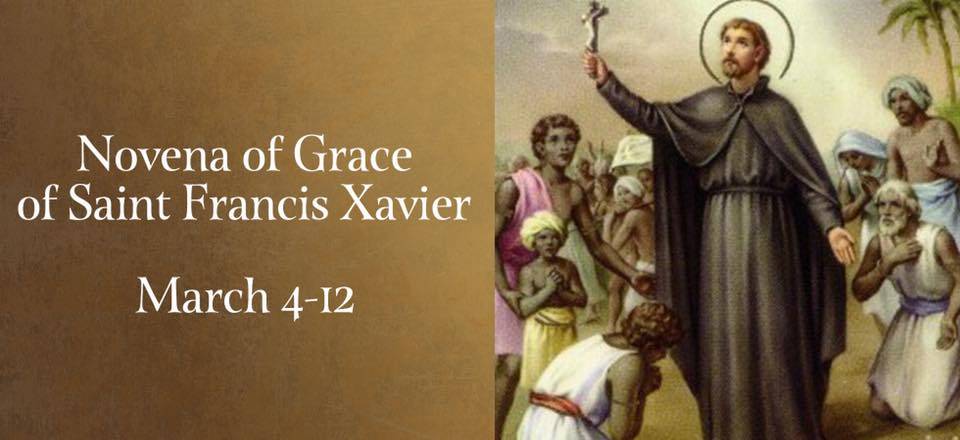
Novena of Grace Day 5
Today’s gospel of Jesus meeting the woman at the well is a remarkable story about a remarkable woman. And we don't know her name, do we? Christian tradition attests that her name was Saint Photina, or in the Slavic churches, the Slavic Orthodox churches, they refer to her as Saint Svetlana. In either case, the name means the enlightened one. Not in the Buddhist sense of enlightenment but enlightened in the sense that there was something about her that just glowed.
She was luminescent. It's like she glowed in the dark. Whatever it was, We do know that she was one of Christ's first evangelists, one of the first ones to go out and proclaim, hey, this guy, he's the Christ. He's the one we've been waiting for. But what's truly remarkable about her is not the fact that she proclaimed the good news. What's truly remarkable, I find, about her is everything that led her to that moment. Now there are some details in this gospel. I know we hear this gospel very often, every year, every Lent. But there are some details in this gospel that I want to point out, because I think they can so often go unnoticed. And they really point to something incredibly powerful about this story.
So, the first detail is this. The gospel tells us that the woman had been married five times, and that the woman, I'm sorry, that the man that she was with was not her husband. Now here's what's curious about that. The Samaritans followed the same law that the Jews followed. And in that law, you couldn't get married five times. That was not permitted. You couldn't just get a divorce and then go find someone else and get a divorce and find someone else. They weren't Kardashians. Sorry, that was a low shot. Anyway, so what was going on with that? Well, there was a law, there was a provision in the law. Here's one theory. There was a provision in the law that if there was a poor family, the father would be allowed to sell off one of his daughters. Yeah, he could sell her off to another man. The man had to be an Israelite, but he could sell that daughter to that other Israelite in order to get the money to sustain the rest of the family. Essentially, that's Prostitution, is it not? That's sex slavery. And after he sells the woman to the other man, if that man grows tired of the woman, he could sell her to another man. And when he gets tired of her, guess what? He could sell her to another man. So, what is the situation that we're really looking at here? Is this a woman who was just hopping from man to man because she couldn't make up her mind? No. I think we're dealing with a situation here that we would call today, we would call it sex trafficking. In those days, they would have called it concubinage. But here's the thing. If you were somebody's concubine, you could call that person your husband or that man could call you, his wife. But it meant something very different than what we mean today. There was no obligation. There was no marital obligation to your wife because women had no rights in those days.
So, there was nothing like that, nothing like the love that we talked about today. And so, there's this situation. And that leads me to the second detail in this story that I want to highlight for you. Did you catch what time of day it was that she went to the well? It says the sixth hour. Now the sixth hour in the Semitic world, even today, the sixth hour would have been midday, would have been noontime. Now, if you ever carried water, you know you don't go to the well at noontime. That's the hottest time of day. You go first thing in the morning. And so first thing in the morning, that's when all the women would have gathered around the well to fetch their water. But this woman chose to go at the time of day when no one else was there. Now, why do you think that was? Do you think that maybe there was a lot of in the background whenever she walked by? Do you think that there were rumours about her? Do you think that people talk bad about her? Absolutely. I don't know if you all are from Dublin or if you're from a small town. I work in Belize. The whole country is a small town. And everybody knows each other's business, right? And so, I can only imagine how bad it would have been for this woman. And so, she picked the worst time of day, the time of day when no one else was around to go get her chores done. And that's the incredible thing.
You know, so often when you hear interpretations of this Gospel, this woman is presented as a dissolute woman. But I think the Gospel of John portrays her as a very lonely person. Somebody who has been so badly mistreated. Somebody who has not experienced the love that she deserves. A woman who's just been passed from man to man. And that brings us to the third detail that I want to point out, that Jesus goes up to her. She doesn't go up to him. He goes right up to her. Two striking things about this. Number one, that Jesus goes to the well. Now, the well, that was the woman's space. No self-respecting man would ever go to the well. That's where women hang out. The second detail is this, that Jesus engages her in conversation. He asks her for water. And again, no self-respecting man, much less a holy man, a preacher, would engage a woman in conversation. That would have been totally improper. But Jesus didn't seem to care about the rules of propriety.
And I got to wonder if Jesus, when he saw this woman, if the first thing he didn't notice was her brokenness and her pain and her loneliness, and that just drew his heart. And he had to go over to her. He had to speak with her. And he had to show her love and respect. And my friends, this is how Jesus heals. This is the living water that he gives. He wasn't hungry for physical water. She was offering him physical water, which would have slaked his thirst. He was offering her living water. And that slakes a spiritual thirst, a thirst that all of us have, but that this woman, in her circumstances, had worse than anybody else. And what was she thirsty for? Respect, love, safety, being seen as a human being. The same things that all of us have, that all human beings have. And Jesus went right to her. and he satisfied that thirst. That's the living water that Jesus is talking about. It satisfies something so deep in us that we might not even know it's there. And this, my friends, this is how Jesus heals us. Jesus doesn't just heal by putting his hands on somebody. No, he heals through his love, through the way he looks at people, The way he reaches beyond the rules of propriety of the day, the way he breaks those rules and touches somebody, that's where the healing comes from. Because when he reaches out and touches, then they know that they are loved by God. That's where healing comes from, sisters and brothers. Whatever other healing may happen, great, but the fundamental is that love of God, that's what heals. And so, the woman was overcome by this healing. She was overcome by this. And you could just see how she got the name Photina or Svetlana, that when she's healed, when she comes to see herself through, not through the eyes of the fellow villagers, but when she comes to see herself through Jesus's eyes, then she sees her beauty and her goodness. And then she begins to glow, then she is shining. and she drops her water bucket, because who needs that anymore? And she runs into the town, and she tells everybody about Jesus.
Her story is our story. Her story is the Christian's story. Her story is Saint Francis Xavier's story. My friends, let's pray that wherever it is in our hearts that we need healing, wherever we feel broken, that we can learn to see ourselves, not through the eyes of the people around us, but that we can learn to see ourselves through the eyes of Christ, who sees our true goodness, our true beauty, our true dignity. And when we do that, let's let ourselves be transformed. And then we go out in the world and share that with others. Amen!
NOW LET US PRAY THE NOVENA PRAYER.
O most kind and loving saint, in union with you I adore the Divine Majesty. The remembrance of the favours with which God blessed you during life, and of your glory after death, fills me with joy; and I unite with you in offering to Him my humble tribute of thanksgiving and of praise, I implore of you to secure for me through your powerful intercession the all-important blessing of living and dying in the state of grace. I also beseech you to obtain the favour I ask in this Novena …...here ask for the favour you wish to obtain…. but if what I ask is not for the glory of God or for the good of my soul, obtain for me what is most conducive to both. Amen.
Let us pray…
O God, who was pleased to gather into your Church the peoples of the East by the preaching and miracles of blessed Francis, mercifully grant that we, who honour his glorious merits, may also imitate the example of his virtues, through Jesus Christ our Lord. Amen.