
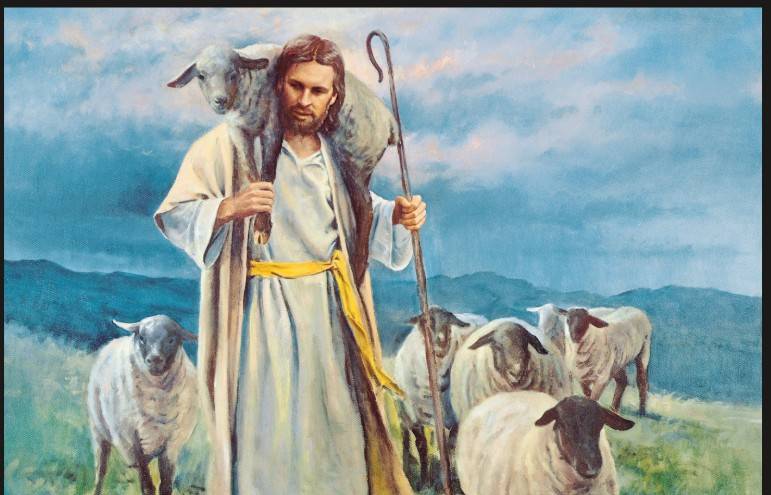
He calls each of his sheep by name - Bishop Erik Varden
John 10.1-10: He calls each of his sheep by name.
Dear friends!
You receive the sacrament of confirmation on the Fourth Sunday of Easter. We call it Good Shepherd Sunday, for on this day we always read from the tenth chapter of John, which contains the parable of the Shepherd and the sheep.
I don’t know if you’ve ever thought what I remember thinking back when I, with a lot of resistance, if the truth be told, was confirmed. When there was talk of the Good Shepherd, or pious images of him were displayed, I groaned. The images irritated me. The Shepherd resembled an old-school hippie.
And was I supposed to count myself a sheep?
Anyone who’s had dealings with sheep knows they’re not especially reflective. Sheep move in flocks. Steer a few in a given direction, and the rest will follow. I, meanwhile, at fifteen, was determined to find my own way in life. I didn’t want to be pulled along in some woolly, smelly heap.
There was something suspicious, too, I thought, about the Shepherd. He made me think of the Pied Piper, the fellow who went about playing a flute prettily while the town’s rats, enchanted, followed him into a river, where they drowned. Is this Christianity, I wondered — the unthinking pursuit of a charismatic leader with no objections raised, no questions heard, only bleats?
Later, when I started reading the Bible and discovered what an exciting, thought-provoking book it is, I saw how wrong I’d been. The people of Israel were nomads. Sheep-farming was the foundation of their society and business. The shepherd became a symbol of political leadership. King David, the personification of a kingly ideal, is called Israel’s shepherd. It’s a title of honour. In the Bible, sheep aren’t just distracted balls of wool. They represent the nation’s citizens. They’re presented as intelligent. Psalm 23, which begins, ‘The Lord is my Shepherd’, speaks of the soul of sheep and of their yearning for righteousness.
In the Bible, a relationship of trust exists between shepherd and sheep. The sheep recognise the voice of the shepherd they trust. They refuse to follow other voices that merely imitate the good shepherd’s voice. The sheep seek security and thriving. They do not give in to threats.
It isn’t, then, a humiliation to be likened to a sheep!
On the contrary. The image suggests that we have exercised discernment, worked out where we want to go in life, have found a leader it is safe and sensible to follow. We have ears that hear, eyes that see.
You who are about to be confirmed were marked with the sign of the Good Shepherd in baptism, becoming part of his flock. That was a gift your parents gave you. Remember to thank them for it. Today you assume adult responsibility for this gift you received as children. You declare yourselves Christians. You say: ‘Yes, I recognise the Good Shepherd’s voice, and I will follow it.’
To be a Christian is not, as I have said, to drift passively along with a crowd or current. It is to listen critically to voices that surround us. We must consider both the message and tone of those voices. Which concord with that of the Good Shepherd? Which try to draw us away from him?
Much is at stake in the world right now, especially for you who are young. Even in Norway, where we’re used to living in stability and security, preparations are made for possible war. There’s a new edge to debate. Old prejudices find new expressions. People insult one another in public. There’s much talk of inclusion and solidarity, true, but what we see is that bridges are burnt and walls constructed as suspicion rises. Our country is becoming more violent.
I say this, not to cast shadows over what should be a bright day. I simply point out something you’re bound to have noticed already: Not all voices about us are good. Not all have honest purposes. There are ‘thieves and robbers’ set on leading you astray. That’s why you need to be able to think for yourselves. To think for yourselves, you need sure criteria and principles. That is what our Catholic faith gives you. It is a joy, and a source of encouragement, that you young people today confess and confirm your allegiance to that faith.
On Good Shepherd Sunday we pray for vocations. In a way that seems superfluous. All of you are called.
God, in whose image you are made, has a task for each of you. To find out what that task is, is part of youth’s terror and exhilaration. Savour the exhilaration and enjoy it! Take time, now and again, to ask: ‘What do I really want? What do I long for?’
Remember: the Good Shepherd’s voice doesn’t just speak from without. It is heard, too, in the heart’s deep desire. Learn to listen out for it there.
All of you are called to live good Christian lives built on truth and love of neighbour. When we talk about vocations, though, we also think specifically of the call to a consecrated life. I invite you to take that option seriously. Who knows if God isn’t calling some of you here to be priests or religious? It’s a good life — to that I can testify. The Church needs young women and men with guts to say a wholehearted ‘Yes!’ to the promises of Christ, ready to establish their life’s task within them as bearers of hope, joy and comfort into an often saddened, sometimes lugubrious world.
‘Christ’, we have heard Peter say, ‘left you an example, that you might follow in his footsteps.’ That’s what life is ultimately about. Remember that, and everything else will fall into place. Amen.