
Facing Fear - Bishop Erik Varden
To prepare myself for our meeting here at Stykkishólmur, I have been dipping into a travel book — not one of the recent ones that seem to speak only of adventure trails and spas, as if Iceland were thought up by God Almighty as a leisure park, but a book written 90 years ago, in 1936, when the poets W.H. Auden and Louis MacNeice spent three months here.
The trip was an adventure to them, too; but an adventure into a natural and human reality they regarded with reverence. Iceland came across as wild in 1936, a place where life was hard but people were hospitable.
No one had thought of a Chai latte back then. One cooked to survive, not to generate gastronomic ‘experience’. The food impressed Auden, who notes, for example, how to get on with the dried fish he found served everywhere. It should, he says, ‘be shredded with the fingers and eaten with butter. It varies in toughness. The tougher kind tastes like toe-nails, and the softer kind like the skin off the soles of one’s feet.’
Auden and MacNeice were both born in 1907. They were 29 years old, joyful and strong, full of sparkle and wit, enthralled by the grandiose nature of this country and by its society, so different from the England and Ireland they came from. Still thirty years later, Auden was pleased to register that ‘modernity does not seem to have changed the character of [Icelanders]. They are still the only really classless society I have ever encountered, and they have not — not yet — become vulgar.’
Yet there was fear in the air. ‘Though writing in a “holiday” spirit’, though having the holiday of their lives, the poets were conscious, writes Auden retrospectively, ‘of a threatening horizon to their picnic — worldwide unemployment, Hitler growing every day more powerful and a world-war more inevitable. Indeed the prologue to that war, the Spanish Civil War, broke out while we were there.’
I thought of those words while reading the paper on the plane yesterday.
Pundits disagree on whether the Third World War has already begun. Since 2022 we have, in the Nordic countries, followed with pain and anxiety the grinding continuity of Russia’s war of aggression in Ukraine. Russia is our neighbour, too. Our countries are rearming. We are watching our boundaries to the East and to the West.
Greenland was, not long ago, at the centre of the world’s attention as the president of the United States insisted, in less and less diplomatic terms, on his private notion that the territory should really be his.
Gaza is in ruins as a result of the war provoked by the gruesome Hamas attacks on Israel in 2023.
No one knows what the long-term effect of regime change in Venezuela will be, notably what effect it will have on Cuba.
The Israeli-US war on Iran was advertised as the swift cutting of a gordian knot that would produce stability. The US Department of War, which used to be called Department of Defence, announced the operation under the name ‘Epic Fury’, presenting it as ‘laser focused’. That phrase summons up the reassuring image of sophisticated surgery by which a steady surgeon’s hand, assisted by wonderful gadgetry, removes a cancerous growth without damaging healthy tissue, enabling the patient to return home that same day. Furies, though, are now unleashed in the Strait of Hormuz, in the Persian Gulf, in Lebanon, and elsewhere.
Who sows the wind reaps the whirlwind (Hosea 8.7). Fury calls fury forth.
Anyone who thought they were out on a picnic stands corrected. A threatening horizon surrounds us on all sides. Conflicts like those mentioned — and God knows they are not the only ones — coincide with environmental change, the unpredictable rise of AI, and weird virtual addictions. We are left feeling under threat not only on the human and political, but also on the natural and digital level.
This state of affairs is found by many to be overwhelming. Mental health needs are growing exponentially, notably among the young. Many say they simply do not know, now, where existence is pointed. That confusion can seem too much to bear.
Meanwhile, voices of more or less self-proclaimed prophetic authority loudly profess that they know exactly where the world is going, and that there is no getting away from it. A couple of weeks ago, Alexander Dugin, whose influence on the president of Russia has often been remarked on, publicly envisaged the onset of an end-time battle, the war of all wars that will, he thinks, probably bring an end to history. Dugin’s discourse is a mixture of political analysis and apocalyptic symbolism drawn from Scripture. Dugin speaks of a ‘sacred mission’ to ‘stop the civilisation of Baal’. The victory he looks towards has little to do with the prospect of an evangelical reign of justice and peace in love, however; in fact, it is itself marked by the Baalist characteristics of a god who devours his children.
What a setting in which to be a bishop these days!
The task entrusted to us is grave. At the same time it is beautiful. The world is caught up in a maelstrom of violence, fear, duplicity, and sheer madness. Yet over this chaos the Spirit hovers, not menacingly, but benignly. The Spirit, of course, is the Spirit of justice and truth. The Spirit will have no truck with injustice and untruth. Where worldly tendencies marked by sin pull what is whole apart, the Spirit unites. The Spirit unites by setting right boundaries, not by compromise.
Our political and cultural climate is marked by fierce polarisation and by an increasingly aggressive, belligerent tone, even among those who call themselves believers.
But the Church must follow a different path; she must show that such a path is humanly possible, for it is her task to let God’s peace become flesh. We cannot be content just to stand around and tell people to be nice to one another. We must show what a renewed humanity looks like. Only such renewal can save us from the constant acceleration of confrontations.
I know it can seem bombastic to begin our conference, a modest gathering, on such a note. I am no political analyst. I am no theoretician of culture. I simply want to share with you a deep conviction: this is a decisive and fearful time for Europe and for the world. Into this time we must speak Christ’s peace, a peace not like that which the world gives piecemeal.
Christ’s peace is no transaction, no pragmatic ‘deal’. It is the fruit of an all-encompassing sacrifice brought in love, accomplished once for all on Calvary, and renewed every day on our altars. What we must do above all, now, is to let that sacrifice work, to teach the faithful by word and example what it means to live in the spirit of that sacrifice, in the confidence that God, through his holy Church, is still working out the salvation of mankind. God saves us from evil. He also saves us from ourselves.
This is a time in which to draw a line between what matters and what does not; this is no time for vanity, trifles, or silly little squabbles.
Today the Church celebrates St Patrick, a Romano-British soldier abducted by Irish pirates in the early fifth century. Time in slavery made him reflect on the sense of existence. Released, returned to Britain, he became a Christian. He did not, though, turn his back on the land in which he had been unfree. No, that land occupied his thoughts. It attracted his love. He went back to Ireland and worked, first as a priest, then as a bishop, in unspectacular ways, the way any priestly or episcopal life is made up chiefly of ordinary things.
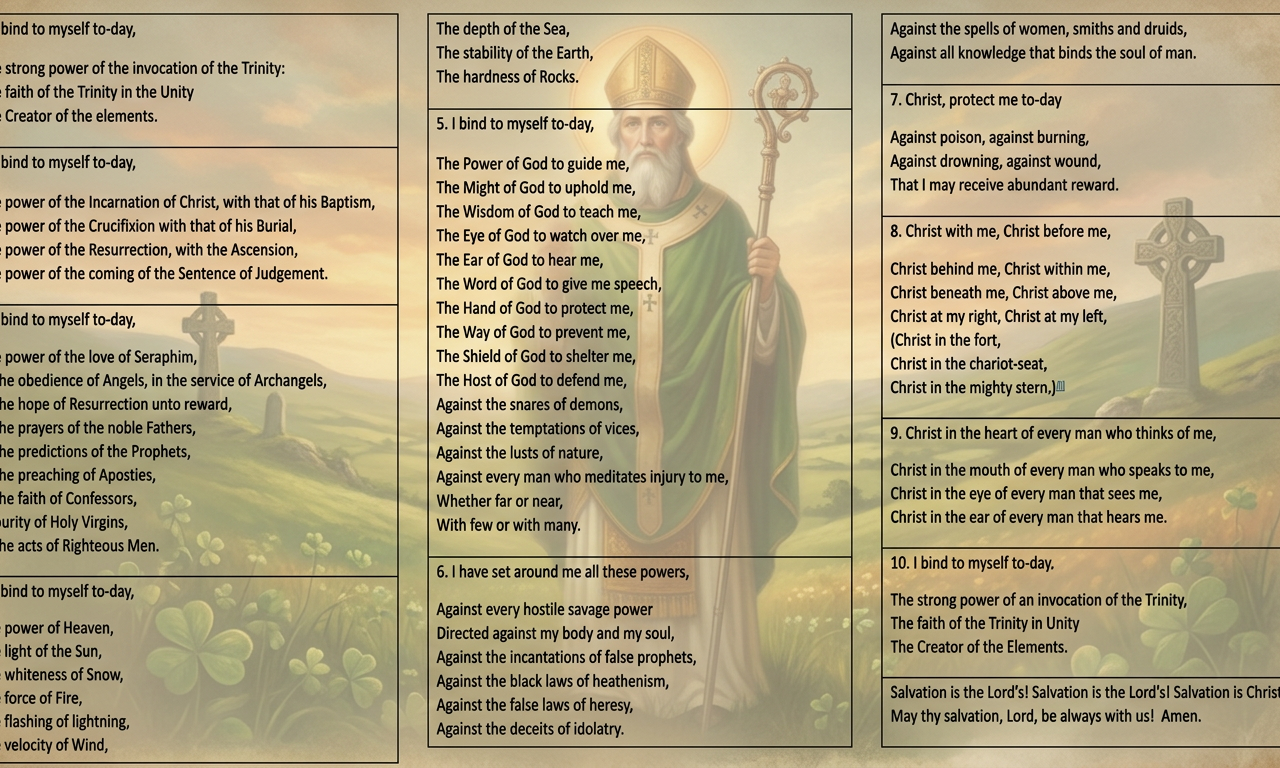
This one man’s givenness, though, left its mark on a nation. So deep is that mark that even secular, repaganised Ireland sees itself reflected in the glory of St Patrick and that, wherever the Irish have worked or settled, from New York to Lagos, Patrick is held in highest honour. Not all of us are called to be a St Patrick; but his example speaks to us all. Like him we can carry light into darkness. We can refuse to be crippled by the threats of those who would frighten us. We can put our whole trust in Christ’s power to save. If the shepherd is fearless, the chances are, the flock will be, too. St Patrick sang, in the prayer known as his Breastplate:
I bind to myself to-day,
The Power of God to guide me,
The Might of God to uphold me,
The Wisdom of God to teach me,
The Eye of God to watch over me,
The Ear of God to hear me,
The Word of God to give me speech,
The Hand of God to protect me,
The Way of God to prevent me,
The Shield of God to shelter me,
The Host of God to defend me,
Against the snares of demons,
Against the temptations of vices,
Against the [lusts] of nature,
Against every man who meditates injury to me,
Whether far or near,
With few or with many.
It is possible to live in this way. If a sufficient number of people do, they can actually transform society. The Church, a little flock, can reveal itself, then, the seed of a new humanity. A threatening horizon can turn into a sunrise full of sweet hope.
That’s what we’re about, surely.
Everything else must be seen in this light.