
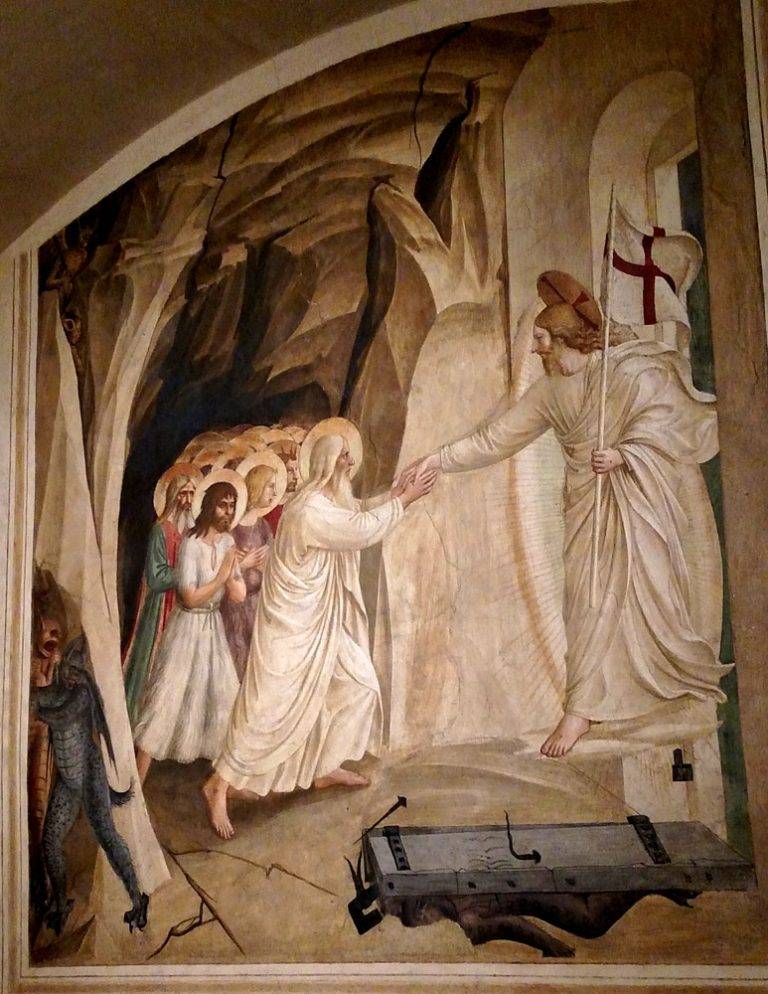
Easter Vigil - Bishop Erik Varden
https://coramfratribus.com/
The character of death is relentless. Death marks an absolute divide. We’re either alive or dead. There’s no in-between. Anyone who has sat at a death-bed knows what I mean. The dying person may be in a coma; we may struggle to see whether he or she is breathing; but they are there. Then death comes, and we are left utterly alone, just with a lifeless body, conscious of an explicit, piercing absence.
Since death so clearly marks a limit, people have always regarded it with respect. This holds for all religions. It holds for most materialists as well, even if some tend, now, to present death as a product one might, and should, pre-order. The irreversibility of death is not reduced thereby. In a way it is accentuated.
An encounter with death can provoke rage, especially when children die or someone perishes by violence or accident. We spontaneously think: ‘It shouldn’t be like this!’ Our inner rebellion can take desperate, grotesque, even absurd forms.
An encounter with death can provoke deep longing. What wouldn’t we give to sit, once again, before the fire with someone we love who has died, to talk confidentially, to get a hug, to hear a laugh we may be missing sorely?
Death puts us humans in our place; it humiliates and overwhelms us; but doesn’t entirely convince us. Deep even in the souls of atheists, who insist that souls don’t exist, there’s a suspicion that death is really unreal, a performance that will as the curtain goes down, the light comes on, and we go into the air. There’s just to much life in a human being for it to be switched off as if it were a gadget.
Easter confirms our suspicion. Easter unmasks death as an impostor. Our maddest desire turns out reliable: we may live for ever. In us there is an essential core that cannot die, created to move into an ever more intense kind of life.
The Easter Vigil lets us contemplate this truth in a perspective reaching from creation to the end of time. The central point of that history is the resurrection of Jesus, the Son of God, from the dead.
Christ’s rising is the true Big Bang thanks to which it means something that the world exists. If human death is swallowed up by divine power, then all our experience, all our insight has eternal consequence. Life can’t be limited, then, to monotonous cycles of buy-use-discard, of desire-satisfaction-new desire.
No, in the light of the resurrection our existence unfolds limitlessly. An exultation vibrates in all things. We ascertain that nothing, and no one, is hopeless.
Jesus’s victory over death calls out to us: ‘Get ready to live!’ May we rise to the measure of what is promised and given us.
Amen. Alleluia!