
Easter Sunday - Bishop Erik Varden
The image of these two men running through Jerusalem in the darkness before dawn, with Mary trailing behind, is a good, true image of what it means to live by faith. The believer does not always bask in the warm, contended certainty of possessing answers to all life’s questions. The believer is someone who, ever anew, lets himself be challenged by the thought, ‘But what if everything Jesus said and taught is in fact real and liveable?’, who determinedly sets about trying it out, forming his life by his faith, and doesn’t just swan around prattling about it.
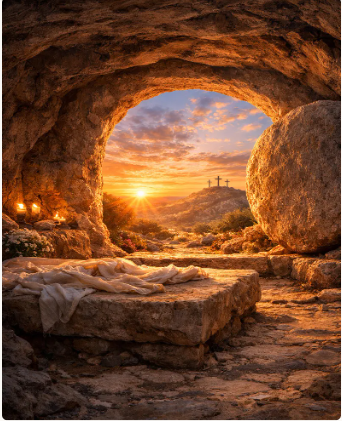
When Peter and John arrive, they see that everything is the way Mary had said. They see the emptiness. They see the linen cloths on the ground. These must be significant. If someone comes to steal a dead body, they surely don’t undress it first? The cloth that had rested on Jesus’s face lies in a place by itself, neatly rolled up, the way a courteous guest, after staying overnight with friends, will fold his bed linen on departure, as a little gesture of gratitude to his hosts.
The things the disciples observe feed their detective work. By deductive reasoning, they try to work out what has happened. Illumination comes, though, at a different level. ‘Peter’, we have heard, ‘saw and believed’.
‘Belief’ denotes, here, recognition of connectedness. Peter sees beyond his immediate grief, his intimate betrayal. He remembers his own confession at Caesarea: ‘You are the Son of God!’ He remembers the light seen on Tabor, the raising of the widow’s son at Nain, the fish with the gold coin in its mouth that made Jesus say: ‘Give it for you and me’. You and me! The mere thought of those words is balm to a man who has felt irremediably alone. Peter remembers Jesus’s repeated assurance that all the painful things ‘must’ take place but are not final. ‘When I am risen’, he said, ‘I will go ahead into Galilee’ (Mt 26.32).
Has this ‘when’ occurred?! Has he in truth passed through death?!
That night Peter meets the Risen One. Jesus comes to the disciples and says: ‘Peace!’ He bids them receive the Holy Spirit. He could have appeared to Peter at the empty tomb. But he didn’t. He wanted Peter first to come to faith by considering his own experience in the light of Jesus’s promises. That is how faith becomes substantial in a life, a foundation on which all else can rest — firm rock, not shifting sand. The humiliated Peter is in this way changed into a courageous witness, as attested by today’s first reading from the Acts of the Apostles.
All of us are called into this coming-to-faith-through-renewed-awareness. Easter asks us to reread our whole life, our failures as well as our achievements, in the light of Jesus’s victory over death in order to ascertain, not just on the basis of stuff we’ve read or watched on YouTube, but from experience: ‘He is risen!’
That is how we become credible witnesses, fit to carry his Gospel to the ends of the earth.
Amen. Alleluia!