
Desert Fathers 45
A man hunting wild beasts found himself in the desert. He saw Abba Antony at recreation with the brothers and was scandalized. The elder decided to make him understand that now and again one has to encounter the brethren at their own level. He said to him: ‘Take an arrow, put it to your bow, and pull!’ He did just that. Then he said again: ‘Pull more!’ And he pulled. And again, Abba Antony said: ‘Pull!’ But the hunter replied: ‘If I pull beyond measure, I will break the bow.’ Abba Antony said to him: ‘It is exactly the same when it comes to the work of God. If we stretch the brothers excessively, they will be shattered. So now and again we must encounter them at their own level.’ Hearing this, the hunter was filled with understanding. He went away greatly profited by the elder. As for the brethren, they returned to where they lived with new strength.
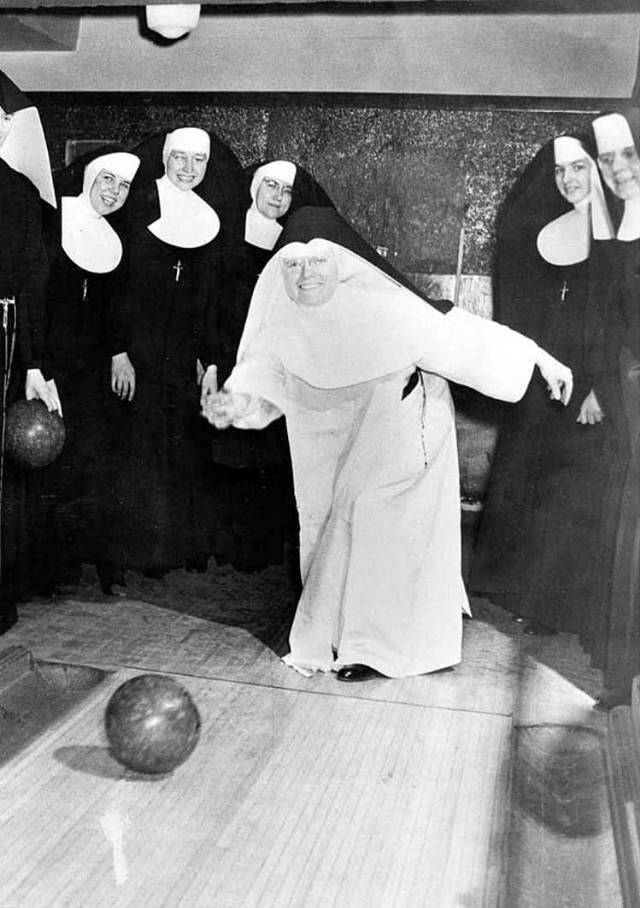
People generally have an expectation of priests and nuns that excludes any form of relaxation. That is why they are amused by pictures of nuns on rollerblades or eating ice-cream, or of monks tobogganing. They see them at their own level and think it funny that they might act in this way.
I do not suppose the monks were playing badminton. Most probably they were just sitting around on the ground in lively conversation, enjoying each other’s company. The hunter was upset as he expected them to be austere, world-weary, forbidding-looking creatures who gaze at skulls while scourging themselves. He was not prepared to find them cheerfully at ease. Antony instead of being upset, or of making a sarcastic remark about the world’s hypocrisy, resolved to help the man reach freeing insight.
There is gentle humor in the exercise he proposes. Instead of launching into complicated explanations about the search for balance in life, he uses an analogy the other man will naturally grasp, by asking him to consider how he uses his equipment. We can imagine the hunter standing there, before a half-circle of monks, now suddenly looking deadly serious, pulling and pulling at his bow. Antony waits for him to reach his limit and unwittingly to speak words that will answer his own perplexity. There is a pattern in nature of give-and-take. Relaxation is not a sign of weakness, rather a realization from self-knowledge, which is a form of humility, that recreation is a life balancing requirement.
The idea of leisure is deeply rooted in both monastic and secular life. We can enjoy leisure without being idle. To be idle is to avoid what needs to be done, for selfish reasons, to waste time. Leisure, on the other hand, is in itself a high form of attention. It is a matter of being intensely present; of resting deliberately; of turning away from self towards the other, towards God and the world, in a state of receptivity, marveling at the gift of it all, giving thanks. Such an attitude is a basic requirement to living. It is something we should foster as second nature. Scheduled time of rest is known as ‘re-creation’. We often use the words ‘re-creational activity’. To be a Christian is to let oneself be constantly re-created in Christ. Times of conscious rest are given us as opportunities for conscious consent to this divine work. For how can God fashion his image in us if we are always furiously busy, shaping our own existence within ourselves?